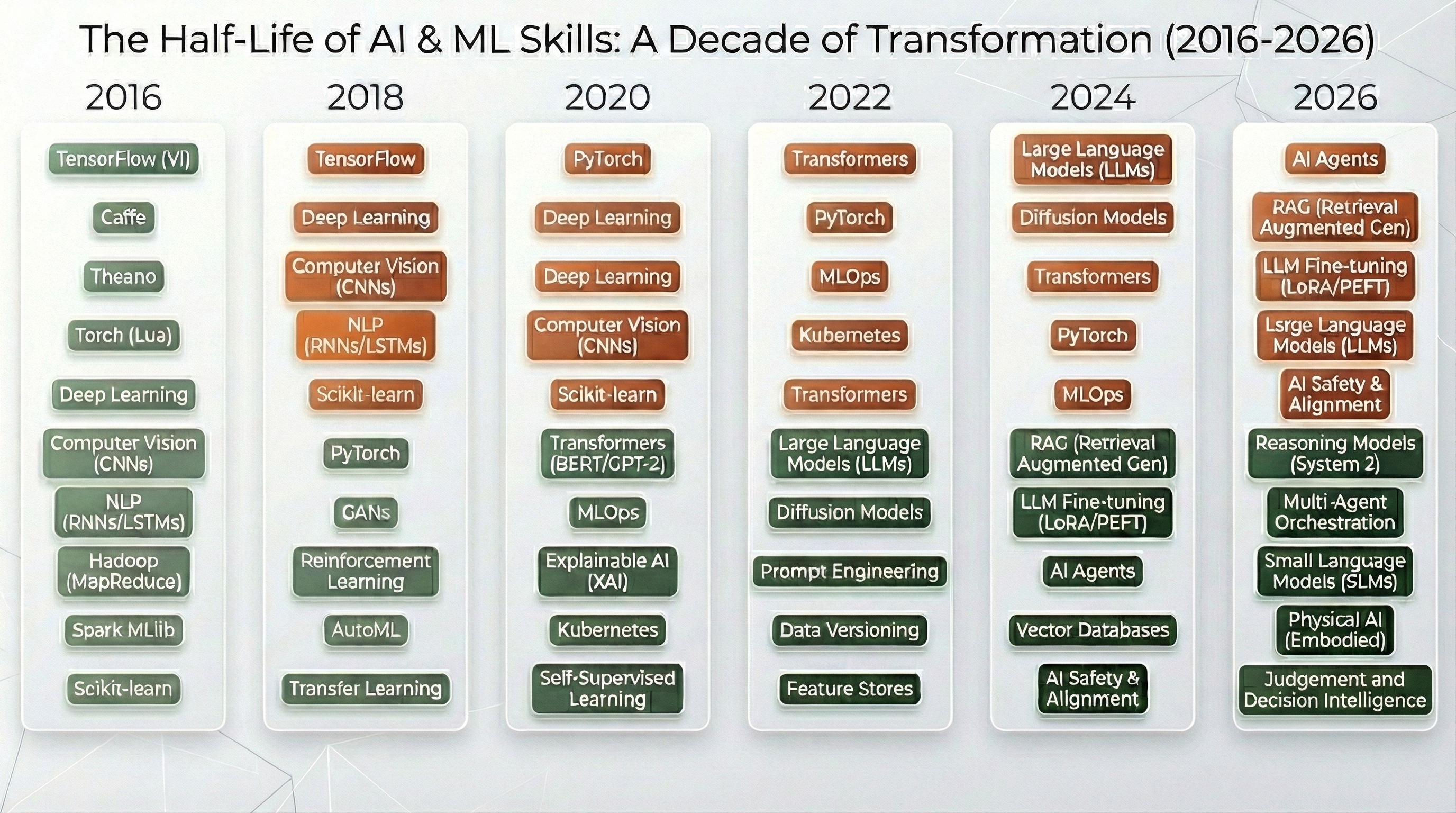
The effect of skills-half life on one's experience in the job market
02 March 2026
On this page 12 items
This article presents a simplified stochastic simulation to illustrate how shrinking skill half-life can mechanically increase structural misalignment in the labour market. It is a mechanism demonstration, not a forecast.
TL;DR:
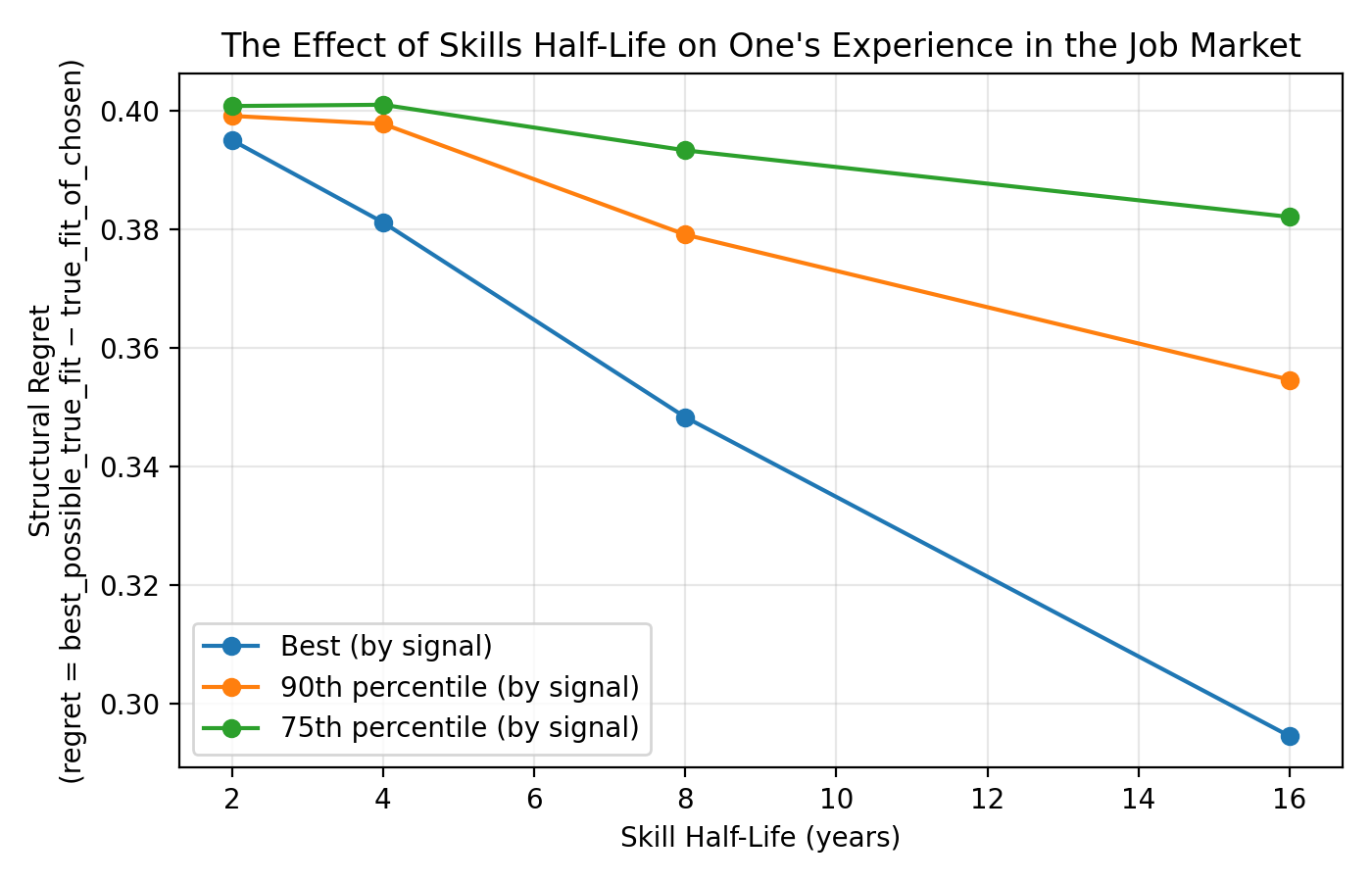
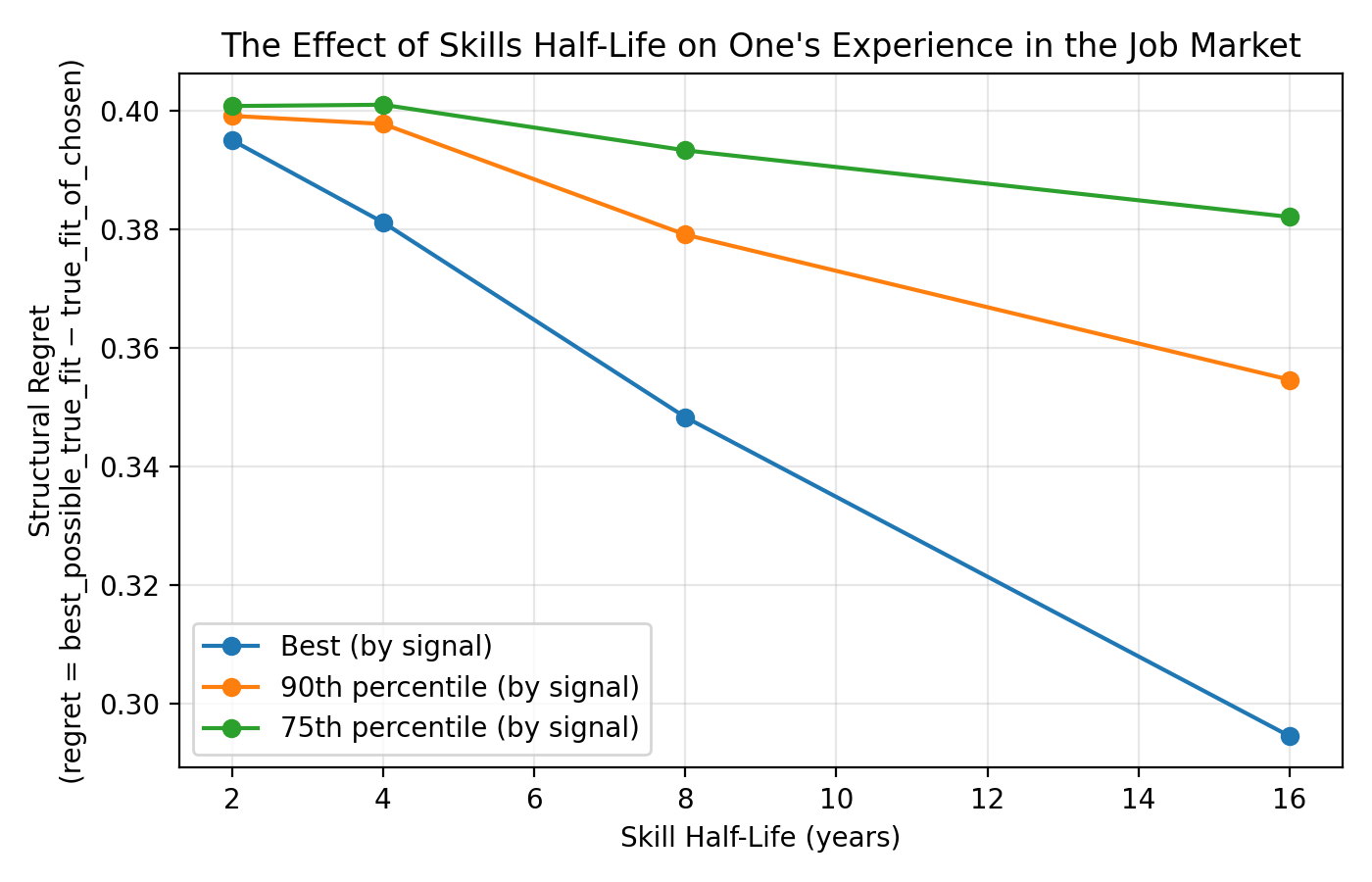
In a 2-year half-life market (today), even if you are genuinely the top candidate, the system can treat you the way it used to treat a 75th-percentile candidate in an 8-year half-life market (roughly a decade ago).
1. Model Overview
We simulate:
- Candidates with evolving skill vectors
- Jobs with evolving requirement vectors
- Hiring decisions made using lagged signals
- A structural misalignment metric called regret
The goal is to understand how shrinking skill half-life changes the experience of candidates in the job market.
2. Representing Skills and Jobs
Let:
- = candidate at time
- = job at time
Similarity is measured via cosine similarity:
Summary: Fit equals the dot product between candidate and job vectors.
3. Encoding Skill Half-Life
Quarterly update step:
Decay parameter:
Skill evolution:
After years:
Summary: After years, only 50% of original skill variance remains.
4. Asymmetric Drift
Jobs drift faster than candidates:
Interpretation: Hiring mandates evolve faster than people reskill.
5. Adaptation Mechanism
Market mean:
Candidate update:
where .
Summary: Candidates adapt, but toward a moving target.
6. Signal Lag
Hiring decisions rely on stale information:
- CV lag = 2 quarters
- JD lag = 1 quarter
Signal similarity:
True similarity:
7. Structural Regret
Oracle best:
Regret:
Average regret:
Summary: Regret measures the gap between chosen candidate and true best.
8. Experimental Setup
| Parameter | Value |
|---|---|
| Dimension | 50 |
| Candidates | 400 |
| Jobs | 150 |
| Steps | 60 quarters |
| Burn-in | 30 quarters |
| CV Lag | 2 |
| JD Lag | 1 |
Half-life values tested:
9. Simulation Flow
10. Results
Y-axis definition:
11. Interpretation
- Regret declines as half-life increases.
- Precision matters more in stable regimes.
- Drift dominates in high-volatility regimes.
At , even selecting the best candidate by signal produces substantial regret.
12. What This Means
When skill half-life shrinks:
- Drift dominates
- Signal lag injects structural error
- Misalignment becomes a system property
Recruitment and L&D must evolve toward continuous alignment systems in a high-volatility world.